by Michael Kontopoulos
Showing posts with label research. Show all posts
Showing posts with label research. Show all posts
Monday, May 4, 2009

Tuesday, April 21, 2009
Boris Savelev
A former rocket scientist, Boris Savelev has been documenting Russia through his lens for the last 31 years. His first exhibition in the UK opens 21 April 2009 at the Michael Hoppen gallery, London, where over 30 of his photographs will be on show. His works of elegant observational realism are preoccupied with light and form – a constructivist aesthetic Savelev credits to his 'methodical, scientific background'. Both melancholic and playful, Savelev's photographs capture the social and political upheaval of the former Soviet Union, by 'simply having a gut feeling for that fleeting moment'. Here, he talks us through 10 works from his show source


Friday, April 10, 2009


Tuesday, April 7, 2009
Truth and Lies in Photography College Project (Spank Moons) Research and own work


JERUSALEM - Twee rechtse kranten in Israël hebben twee vrouwen op een foto van het nieuwe kabinet van Israël weggesneden en twee mannen ervoor in de plaats gezet.
In de religieuze krant Yated Ne'eman zijn de vrouwelijke leden van de nieuwe regering, Limor Livnat and Sofa Landver, vervangen door de silhouetten van twee mannelijke ministers.
In de krant The Maariv werden Livnat and Landver gewoon zwart gemaakt.
De ultra-orthodoxe kranten weigeren foto's van vrouwen te publiceren.

source
Sunday, March 29, 2009
Friday, March 27, 2009
Sunday, March 15, 2009
Truth and Lies in Photography College Project (Spank Moons)
'over waarheid en leugen...
min. 7 werken
Benadering can documentair/enscenerend/studio zijn
Onderzoek naar deze zeer specifieke begrippen. Hun impact. Bestaan ze eigenlijk wel binnen de context van de fotografie? De opdracht is een sleutel naar autonoom werk.
Looking at truth and lies in photography and their impact on the medium. Do they actually exist within the context of photography?
I think I'm going to take a cue from Stalin in this project, and use his photo manipulation in his propaganda as a starting point for the fictionalisation of my family photos.
For this project, I propose to censor out people/things/happenings from my life that I would have attached negative connotations to. A childhood bully, an embarrassing moment in the school play, etc. I'll airbrush my life, so to speak.
here are some examples of Stalinist photo editing (from this wiki page):


min. 7 werken
Benadering can documentair/enscenerend/studio zijn
Onderzoek naar deze zeer specifieke begrippen. Hun impact. Bestaan ze eigenlijk wel binnen de context van de fotografie? De opdracht is een sleutel naar autonoom werk.
Looking at truth and lies in photography and their impact on the medium. Do they actually exist within the context of photography?
I think I'm going to take a cue from Stalin in this project, and use his photo manipulation in his propaganda as a starting point for the fictionalisation of my family photos.
For this project, I propose to censor out people/things/happenings from my life that I would have attached negative connotations to. A childhood bully, an embarrassing moment in the school play, etc. I'll airbrush my life, so to speak.
here are some examples of Stalinist photo editing (from this wiki page):


Monday, March 2, 2009
Research for installation at Jabberwocky1
Silvia Bachli


anna barriball


Sandra Cinto


Joseph Grigely


Nedko Solakov


So, it seems that some of my ideas for this exhibition are very similar to the above artists'approaches (Sandra Cinto in particular). Here are some sketches of possible installation ideas:


anna barriball


Sandra Cinto


Joseph Grigely


Nedko Solakov


So, it seems that some of my ideas for this exhibition are very similar to the above artists'approaches (Sandra Cinto in particular). Here are some sketches of possible installation ideas:


Saturday, November 29, 2008


Thursday, November 6, 2008
Irish Artists brought up in Joint Course
Bea McMahon

McMahon mostly uses video and small drawings to articulate her ideas which weave a strange and boundless path between an inner reality of thought and the ordinary outside world, a world in which her version of events have a somewhat hallucinogenic feel. Even though her practice does not subscribe to an obvious visual lexicon of science, it does rely on thought process she learnt through the study of mathematics – one which exists in a state of logic and before language. Her work forces little gaps to open up, or makes a life moment to come apart into two distinct things, one of which gives way to the other, whilst retaining the memory of the world as it was before. She has chosen, simply for reasons of aptitude, visual art as a medium to explore this process – a thought process which Werner Heisenberg describes as ‘not a precise language in which one could use the normal logical patterns; it is a language that produces pictures in our mind, but together with them the notion is that the pictures have only a vague connection with reality, that they represent only a tendency toward reality’ . In her work is a withdrawal from the search to expose underlying structure towards a position that the action of thinking and feeling is an active force generating the underlying structure.
source
The Bea McMahon piece we watched in the lecture was called Audience and was a short video showing someone playing a snail-infested piano. Exploring the interference attached to the making of art, or on a broader scale the interactions between actor and subject, questions of ethics and responsibility arose. Was it cruel to use snails (involuntary participants) for the sake of art?
Grace Weir

still from Turning Point
Grace Weir studied at the National College of Art and Design and also at Trinity College Dublin, where she won an award for her Masters in Multi-Media graduation project. She co-represented Ireland at the 49th International Venice Biennale in 2001 with her video installation 'around now'. She has exhibited widely both nationally and internationally, most recently seen in 'Biennale! Artist film and video' at Temporarycontemporary in London, ‘As Heavy as the Heavens' at Kunsthallen Brandts Klaedefabrik, in Denmark, 'Tir na nOg' at the Irish Museum of Modern Art , Missing Time at the Agnès b. cinema in Hong Kong, 'Flights of Reality' at Kettles Yard Cambridge UK, in 'Are we there yet'? at Glassbox in Paris, France, and at her solo exhibition at the John Curtin Gallery in Perth, Australia in 2002, and at the RHA Gallery in Dublin in 2000. In 2002 she was commissioned by NIFCA, the Nordic Institute of Contemporary Art in Helsinki Finland to make an interactive work ‘Little Bang' for their online gallery at www.ionic.nifca.org. Grace Weir collaborated with an astrophysicist exploring aspects of Einstein's relativity and was commissioned by Cornerhouse in Manchester UK to make two film works ‘Dust defying gravity' and ‘Bending spacetime in the basement' in regard to this. They were premiered at her solo show titled ‘a fine line' at Cornerhouse, Manchester UK in September 2003. In May 2005 she was elected a member of Aosdána. Her work is held in many collections including that of the Irish Museum of Modern Art.
source
In relation to her work 'the Turning Point', our class discussion turned to the framing of shots and its importance in conveying intention. The link between science and art also came up, as most of Grace Weir's work focuses on 'humanising' this relationship.
Jaki Irvine

still from Room Acoustics Revisited
Irvine currently lives and works in Dublin having spent many years in London and some time in Italy. Her works in film and video, whether in single-screen format or in more complex multi-screen installations, weave together enticing, though ultimately elusive narratives in which image, voice-over and musical score variously overlap, coalesce and diverge. These languid explorations of human interaction with the natural world, the built environment, and with other humans are suffused with a melancholic lyricism and leavened by a dark, dreamlike humour. Subjectivities split and fragment as the boundaries that separate self from other, or human from animal, become fluid or permeable. In 1995 Irvine was included in the seminal exhibition of Young British Artists, General Release, at the Venice Biennale, and she represented Ireland at the 1997 Biennale.
Her solo exhibitions include shows at Project Arts Centre (1996) and the Douglas Hyde Gallery (1999) in Dublin, Frith Street Gallery (1997, 1999) and Delfina Project Space (2001) in London, and the Staatliche Kunsthalle in Baden-Baden, Germany (1998). She has also participated in numerous group shows throughout Europe, Australia and Japan including Sonsbeek International, Arnhem (1993), NoWhere Louisiana Museum of Modern Art, Denmark (1996), White Noise, Bern Kunsthalle, (1998), Intelligence, Tate Britain (2000) and Shifting Ground: 50 Years of Irish Art at the Irish Museum of Modern Art (IMMA) (2000). A major new work, The Silver Bridge, is due to be exhibited at IMMA in Spring, 2004. Irvine is represented in the collections of IMMA, the British Council and in numerous other collections, both public and private.
source
Again, we spoke about her work in relation to filming technique and framing used to convey a particular intent. In Room Acoustics Revisited, Irvine addresses the issue of semiotics and meaning; she uses sheet music as an example of seeing the world 'through a straw'. Limitations of depiction and representation manifest themselves intentionally in the style of the piece, as Irvine plays with the audience and their interaction with the visual and the conceptual sides of her work.
Isabel Nolan

Dublin: Isabel Nolan at Project
And so it stays just on the edge of vision
A small unfocused blur, a standing chill.1
In his poem Aubade, Philip Larkin reflects upon the impending inevitability of death in the lonely darkness of night. He describes the moving shapes that haunt the corners of his vision. As daylight slowly strengthens, his bedroom returns to its normal shape and the presences of the previous night seem strange and out of place.
Everything I said let me explain is the title of Isabel Nolan's recent exhibition at the Project Arts Centre, Dublin. The show is a visual exploration of the thoughts and shapes that occupy the mind at night. Like Larkin, Nolan attempts to interpret how these presences morph and change, grow bright and disappear in order to be felt and understood.
One of the seven artists from the Republic of Ireland selected for this year's Venice Biennale, Nolan's work is primarily concerned with forms of representation and addresses the difficulty of attaching meaning to experience. In this exhibition, drawing is the main discipline through which she expresses her experiences of the night. Along the gallery wall, which was painted a light grey in order to soften the sterilised white, small drawings and paintings explore the shifting shapes of the night-time presence. Many of these shapes have a repeated circular motif, others are more angular. In the centre of the gallery, two mahogany tables present a series of portraits of sleeping faces and another collection of night-time shapes.
Torn from a notebook, these drawings are placed under heavy sheets of glass. They seem to be floating over the dark table top and have an abandoned, spontaneous beauty. Also on the table, a small silver screen plays a short DVD entitled Quiet please, in which most of the drawings on show are animated into a short film. This film begins with a sequence of sleeping portraits and shape drawings. The images are occasionally interrupted with fragments of handwritten text which refer to night-time thoughts. The thoughts shift from simple descriptions - "These presences vary in size, but are never very big" - to more intimate personal reflections - "How could you know what or who you are?"
As the text grows increasingly reflective, the night-time shapes begin to multiply, becoming larger on the screen, filling it completely before receding back into pulsating circles of orange, red and green. Flickering and shimmering, they are the colours seen when you close your eyes.
The tenderness Nolan expresses towards her slumbering subjects is almost palpable in her delicate Sleep sequence drawings, most especially in Sleeping dog. Whilst the exhibition offers many glimpses of intimate narratives, it simultaneously uses tools to prevent the viewer from fully absorbing them. The glass upon the table top or the newsprint that covers the text in Available ensures that elements of Nolan's night-time experiences remain private, almost contradictory.
This contradiction, between the physical intimacy of lying next to someone and the sense of distance experienced when they sleep, is prevalent in the show. Nolan has created a strong visual metaphor for the unaccountable phenomenon that separates two people, even as they lie side by side. Her drawings are an expression of the difference between distance and proximity, sleep and consciousness.
Ciara Healy is an artist and writer based at Pallas Studios; she is currently completing her Ph.D. in Irish curatorial policy at Dublin Institute of Technology.
Isabel Nolan: Everything I said let me explain, Project Arts Centre, Dublin, March - May 2005
source
-visible-state7.gif)
McMahon mostly uses video and small drawings to articulate her ideas which weave a strange and boundless path between an inner reality of thought and the ordinary outside world, a world in which her version of events have a somewhat hallucinogenic feel. Even though her practice does not subscribe to an obvious visual lexicon of science, it does rely on thought process she learnt through the study of mathematics – one which exists in a state of logic and before language. Her work forces little gaps to open up, or makes a life moment to come apart into two distinct things, one of which gives way to the other, whilst retaining the memory of the world as it was before. She has chosen, simply for reasons of aptitude, visual art as a medium to explore this process – a thought process which Werner Heisenberg describes as ‘not a precise language in which one could use the normal logical patterns; it is a language that produces pictures in our mind, but together with them the notion is that the pictures have only a vague connection with reality, that they represent only a tendency toward reality’ . In her work is a withdrawal from the search to expose underlying structure towards a position that the action of thinking and feeling is an active force generating the underlying structure.
source
The Bea McMahon piece we watched in the lecture was called Audience and was a short video showing someone playing a snail-infested piano. Exploring the interference attached to the making of art, or on a broader scale the interactions between actor and subject, questions of ethics and responsibility arose. Was it cruel to use snails (involuntary participants) for the sake of art?
Grace Weir

still from Turning Point
Grace Weir studied at the National College of Art and Design and also at Trinity College Dublin, where she won an award for her Masters in Multi-Media graduation project. She co-represented Ireland at the 49th International Venice Biennale in 2001 with her video installation 'around now'. She has exhibited widely both nationally and internationally, most recently seen in 'Biennale! Artist film and video' at Temporarycontemporary in London, ‘As Heavy as the Heavens' at Kunsthallen Brandts Klaedefabrik, in Denmark, 'Tir na nOg' at the Irish Museum of Modern Art , Missing Time at the Agnès b. cinema in Hong Kong, 'Flights of Reality' at Kettles Yard Cambridge UK, in 'Are we there yet'? at Glassbox in Paris, France, and at her solo exhibition at the John Curtin Gallery in Perth, Australia in 2002, and at the RHA Gallery in Dublin in 2000. In 2002 she was commissioned by NIFCA, the Nordic Institute of Contemporary Art in Helsinki Finland to make an interactive work ‘Little Bang' for their online gallery at www.ionic.nifca.org. Grace Weir collaborated with an astrophysicist exploring aspects of Einstein's relativity and was commissioned by Cornerhouse in Manchester UK to make two film works ‘Dust defying gravity' and ‘Bending spacetime in the basement' in regard to this. They were premiered at her solo show titled ‘a fine line' at Cornerhouse, Manchester UK in September 2003. In May 2005 she was elected a member of Aosdána. Her work is held in many collections including that of the Irish Museum of Modern Art.
source
In relation to her work 'the Turning Point', our class discussion turned to the framing of shots and its importance in conveying intention. The link between science and art also came up, as most of Grace Weir's work focuses on 'humanising' this relationship.
Jaki Irvine
still from Room Acoustics Revisited
Irvine currently lives and works in Dublin having spent many years in London and some time in Italy. Her works in film and video, whether in single-screen format or in more complex multi-screen installations, weave together enticing, though ultimately elusive narratives in which image, voice-over and musical score variously overlap, coalesce and diverge. These languid explorations of human interaction with the natural world, the built environment, and with other humans are suffused with a melancholic lyricism and leavened by a dark, dreamlike humour. Subjectivities split and fragment as the boundaries that separate self from other, or human from animal, become fluid or permeable. In 1995 Irvine was included in the seminal exhibition of Young British Artists, General Release, at the Venice Biennale, and she represented Ireland at the 1997 Biennale.
Her solo exhibitions include shows at Project Arts Centre (1996) and the Douglas Hyde Gallery (1999) in Dublin, Frith Street Gallery (1997, 1999) and Delfina Project Space (2001) in London, and the Staatliche Kunsthalle in Baden-Baden, Germany (1998). She has also participated in numerous group shows throughout Europe, Australia and Japan including Sonsbeek International, Arnhem (1993), NoWhere Louisiana Museum of Modern Art, Denmark (1996), White Noise, Bern Kunsthalle, (1998), Intelligence, Tate Britain (2000) and Shifting Ground: 50 Years of Irish Art at the Irish Museum of Modern Art (IMMA) (2000). A major new work, The Silver Bridge, is due to be exhibited at IMMA in Spring, 2004. Irvine is represented in the collections of IMMA, the British Council and in numerous other collections, both public and private.
source
Again, we spoke about her work in relation to filming technique and framing used to convey a particular intent. In Room Acoustics Revisited, Irvine addresses the issue of semiotics and meaning; she uses sheet music as an example of seeing the world 'through a straw'. Limitations of depiction and representation manifest themselves intentionally in the style of the piece, as Irvine plays with the audience and their interaction with the visual and the conceptual sides of her work.
Isabel Nolan

Dublin: Isabel Nolan at Project
And so it stays just on the edge of vision
A small unfocused blur, a standing chill.1
In his poem Aubade, Philip Larkin reflects upon the impending inevitability of death in the lonely darkness of night. He describes the moving shapes that haunt the corners of his vision. As daylight slowly strengthens, his bedroom returns to its normal shape and the presences of the previous night seem strange and out of place.
Everything I said let me explain is the title of Isabel Nolan's recent exhibition at the Project Arts Centre, Dublin. The show is a visual exploration of the thoughts and shapes that occupy the mind at night. Like Larkin, Nolan attempts to interpret how these presences morph and change, grow bright and disappear in order to be felt and understood.
One of the seven artists from the Republic of Ireland selected for this year's Venice Biennale, Nolan's work is primarily concerned with forms of representation and addresses the difficulty of attaching meaning to experience. In this exhibition, drawing is the main discipline through which she expresses her experiences of the night. Along the gallery wall, which was painted a light grey in order to soften the sterilised white, small drawings and paintings explore the shifting shapes of the night-time presence. Many of these shapes have a repeated circular motif, others are more angular. In the centre of the gallery, two mahogany tables present a series of portraits of sleeping faces and another collection of night-time shapes.
Torn from a notebook, these drawings are placed under heavy sheets of glass. They seem to be floating over the dark table top and have an abandoned, spontaneous beauty. Also on the table, a small silver screen plays a short DVD entitled Quiet please, in which most of the drawings on show are animated into a short film. This film begins with a sequence of sleeping portraits and shape drawings. The images are occasionally interrupted with fragments of handwritten text which refer to night-time thoughts. The thoughts shift from simple descriptions - "These presences vary in size, but are never very big" - to more intimate personal reflections - "How could you know what or who you are?"
As the text grows increasingly reflective, the night-time shapes begin to multiply, becoming larger on the screen, filling it completely before receding back into pulsating circles of orange, red and green. Flickering and shimmering, they are the colours seen when you close your eyes.
The tenderness Nolan expresses towards her slumbering subjects is almost palpable in her delicate Sleep sequence drawings, most especially in Sleeping dog. Whilst the exhibition offers many glimpses of intimate narratives, it simultaneously uses tools to prevent the viewer from fully absorbing them. The glass upon the table top or the newsprint that covers the text in Available ensures that elements of Nolan's night-time experiences remain private, almost contradictory.
This contradiction, between the physical intimacy of lying next to someone and the sense of distance experienced when they sleep, is prevalent in the show. Nolan has created a strong visual metaphor for the unaccountable phenomenon that separates two people, even as they lie side by side. Her drawings are an expression of the difference between distance and proximity, sleep and consciousness.
Ciara Healy is an artist and writer based at Pallas Studios; she is currently completing her Ph.D. in Irish curatorial policy at Dublin Institute of Technology.
Isabel Nolan: Everything I said let me explain, Project Arts Centre, Dublin, March - May 2005
source
Sunday, October 19, 2008
Visit to IMMA 19/10/08
Exquisite Corpse
Exquisite Corpse is an exhibition of 17 works from the IMMA Collection that seeks to reveal a variety of perspectives on the Collection. The title of the exhibition is drawn from the game ‘Exquisite Corpse’ which was invented by the Surrealists in 1925 where a collection of words or images are collectively assembled. In this case the game’s structure is used to tap into the eclectic character of IMMA’s Collection through the choices and viewpoints of individuals from a broad spectrum of the arts including Dawn Ades, Gerald Barry, Aileen Corkery, Barrie Cooke, Michael Craig-Martin, Mark Garry, Deirdre Horgan, Jaki Irvine, Nicola Lees, Tony Magennis, Lisa Moran, Frances Morris, Colm Tóibín and Mick Wilson.
The ‘exquisite corpse’ principle provides a framework for the exhibition, with each participant selecting a work that responds to the work selected by the previous participant. Following the Surrealists’ methodology participants are only aware of the work that is selected immediately before them. The nature of the exhibition is that the final outcome of the show is largely unpredictable and partly determined by chance. However, it is likely that the exhibition will include a wide selection of works ranging from different eras made in a variety of media. While Exquisite Corpse depends on the participants’ having some previous experience of IMMA’s Collection, their knowledge of the collection will have developed individually and may be haphazardly constructed. As a result, their curatorial choices will inevitably be highly subjective, a point that affords the opportunity of revealing perceptions of IMMA and the audience’s experience of its Collection. source
Self as Selves


Self as Selves is an exhibition of works from the IMMA Collection which explores the nature of ‘self’, as being a series of transitory states, always provisional, never fixed. The selected works invoke intersecting notions of self – internal and external, corporeal and conceptual, personal and collective.
The exhibition wishes to address this premise not only in terms of what certain artworks may suggest about their maker’s investigation of self but also to what extent they implicate the viewer in a reciprocal flow of shifting states. To varying degrees the selected works summon the viewer’s participation for their completion, thereby eliciting a range of selves or ‘roles’ through which the viewer may consider their own subjectivity and the nature of their looking.
The artists included in this exhibition are: Marina Abramovic, Janine Antoni, Fergus Byrne, Maud Cotter, Gerard Dillon, Marcel Duchamp, Fiona Hallinan and Caoimhin O’Rathaillaigh, Ellen Gallagher, Antony Gormley, Ann Hamilton, Brian O’Doherty/Patrick Ireland, Dusan Kusmic, Julio Le Parc, Juan Muñoz, Isabel Nolan, Hermione Wiltshire and Paul Winstanley
Curatorially, this exhibition has evolved from a preceding IMMA event, The Burial of Patrick Ireland, which saw the ritualised disposal of an artistic persona with a wake, funeral and burial in the grounds of the museum. Throughout his career as an artist and a writer, Brian O’Doherty/Patrick Ireland has invoked several aliases through which he has explored the nature of identity and the notion of self as more than a singularity. source
Exquisite Corpse is an exhibition of 17 works from the IMMA Collection that seeks to reveal a variety of perspectives on the Collection. The title of the exhibition is drawn from the game ‘Exquisite Corpse’ which was invented by the Surrealists in 1925 where a collection of words or images are collectively assembled. In this case the game’s structure is used to tap into the eclectic character of IMMA’s Collection through the choices and viewpoints of individuals from a broad spectrum of the arts including Dawn Ades, Gerald Barry, Aileen Corkery, Barrie Cooke, Michael Craig-Martin, Mark Garry, Deirdre Horgan, Jaki Irvine, Nicola Lees, Tony Magennis, Lisa Moran, Frances Morris, Colm Tóibín and Mick Wilson.
The ‘exquisite corpse’ principle provides a framework for the exhibition, with each participant selecting a work that responds to the work selected by the previous participant. Following the Surrealists’ methodology participants are only aware of the work that is selected immediately before them. The nature of the exhibition is that the final outcome of the show is largely unpredictable and partly determined by chance. However, it is likely that the exhibition will include a wide selection of works ranging from different eras made in a variety of media. While Exquisite Corpse depends on the participants’ having some previous experience of IMMA’s Collection, their knowledge of the collection will have developed individually and may be haphazardly constructed. As a result, their curatorial choices will inevitably be highly subjective, a point that affords the opportunity of revealing perceptions of IMMA and the audience’s experience of its Collection. source
Self as Selves
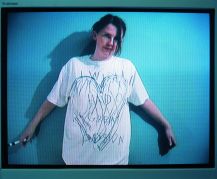
Self as Selves is an exhibition of works from the IMMA Collection which explores the nature of ‘self’, as being a series of transitory states, always provisional, never fixed. The selected works invoke intersecting notions of self – internal and external, corporeal and conceptual, personal and collective.
The exhibition wishes to address this premise not only in terms of what certain artworks may suggest about their maker’s investigation of self but also to what extent they implicate the viewer in a reciprocal flow of shifting states. To varying degrees the selected works summon the viewer’s participation for their completion, thereby eliciting a range of selves or ‘roles’ through which the viewer may consider their own subjectivity and the nature of their looking.
The artists included in this exhibition are: Marina Abramovic, Janine Antoni, Fergus Byrne, Maud Cotter, Gerard Dillon, Marcel Duchamp, Fiona Hallinan and Caoimhin O’Rathaillaigh, Ellen Gallagher, Antony Gormley, Ann Hamilton, Brian O’Doherty/Patrick Ireland, Dusan Kusmic, Julio Le Parc, Juan Muñoz, Isabel Nolan, Hermione Wiltshire and Paul Winstanley
Curatorially, this exhibition has evolved from a preceding IMMA event, The Burial of Patrick Ireland, which saw the ritualised disposal of an artistic persona with a wake, funeral and burial in the grounds of the museum. Throughout his career as an artist and a writer, Brian O’Doherty/Patrick Ireland has invoked several aliases through which he has explored the nature of identity and the notion of self as more than a singularity. source
Wednesday, October 8, 2008
Research for Interrupting the Screen Project
Harun Farocki
Underscoring the political and ideological function of image-making, Farocki's films often combine newsreel, archival, and industrial/technological footage with text or voice narrative in the form of "film-essays."
The subject of retrospectives at the Museum of Modern Art (199) and the Westfalischer Kunstverein (2001), Farocki has stated about his films:
"One must work with existing images in such a way that they become new. There are many ways to do this. Mine is to look for buried meaning and to clear away the debris lying on top of the pictures. In doing so, I try not to add ideas to the film; I try to think in film so that the ideas come out of filmic articulation."
. . .
"Eye/Machine addresses the automation of images in the present era of "smart machines," "smart bombs," and person-less cameras. Deriving from military technology, the first automated images were those photographs taken from airplanes to measure the accuracy of missile drops in World War II. Eye/Machine charts a kind of geneaology from this moment to the current ubiquity of mechanized imaging in the technological and commercial sectors. This film's "launching" image is a grainy black-and-white picture of an airstrip seen through an automated viewfinder. Beneath it, a subtitle reads: "Images like these could be seen in 1991 - of the wart against Iraq/Operational images/Not Propaganda, ye an ad for intelligent machines."
Source: GreeneNaftali Gallery, NYC. Eye/Machine courtesy GreeneNaftali Gallery.
Source
Marie Sester
Marie Sester is a French media artist based in Los Angeles. She began her career as an architect, having earned her master's degree from the Ecole d'Architecture in Strasbourg. Her interest, however, shifted from how to build living structures to how architecture and ideology affect our understanding of the world. Her work investigates the way a civilization originates and creates its forms. These forms are both tangible -such as signals, buildings, and cities- and intangible, such as the aspects of values, laws and culture.
Quoting a profile of Sester written by Holly Willis: "What do these signs, these forms, these things that surround us mean?�? asks the artist. "What do they say about ideology? About capitalism? I realized after I finished my degree that I was interested in architectural forms on all levels, from the concrete elements such as city streets to ideological values, and how they evolve together.�? Marie Sester has received grants and residencies from the IAMAS, in Japan, Creative Capital Foundation, New York, Eyebeam, New York and many others. She has taught in France, Japan, and the United States and has exhibited internationally at SIGGRAPH, Ars Electronica (in the 2003 edition of the festival ACCESS received an Honorary Mention in Interactive Art), La Vilette, etc.
A few months ago, i was visiting the ZKM and i knew her work ACCESS was exhibited there. I had read what the work was about and was expecting to find it in the entrance lobby but i never suspected i'd be so startled and disturbed by it. ACCESS is a robotic spotlight and acoustic beam system that tracks individuals in public places. The beam is either activated as people move through the space under surveillance, or it is piloted remotely using a Web interface. While a friend of mine found the installation quite fun, I felt surprisingly guilty and isolated under that spotlight, exactly what i'd feel if i remembered that i'm under the gaze of surveillance cameras much about everytime i step out of my house. The experience taught me that i should never judge any interactive installation before having tested it myself.
source
Underscoring the political and ideological function of image-making, Farocki's films often combine newsreel, archival, and industrial/technological footage with text or voice narrative in the form of "film-essays."
The subject of retrospectives at the Museum of Modern Art (199) and the Westfalischer Kunstverein (2001), Farocki has stated about his films:
"One must work with existing images in such a way that they become new. There are many ways to do this. Mine is to look for buried meaning and to clear away the debris lying on top of the pictures. In doing so, I try not to add ideas to the film; I try to think in film so that the ideas come out of filmic articulation."
. . .
"Eye/Machine addresses the automation of images in the present era of "smart machines," "smart bombs," and person-less cameras. Deriving from military technology, the first automated images were those photographs taken from airplanes to measure the accuracy of missile drops in World War II. Eye/Machine charts a kind of geneaology from this moment to the current ubiquity of mechanized imaging in the technological and commercial sectors. This film's "launching" image is a grainy black-and-white picture of an airstrip seen through an automated viewfinder. Beneath it, a subtitle reads: "Images like these could be seen in 1991 - of the wart against Iraq/Operational images/Not Propaganda, ye an ad for intelligent machines."
Source: GreeneNaftali Gallery, NYC. Eye/Machine courtesy GreeneNaftali Gallery.
Source
Marie Sester
Marie Sester is a French media artist based in Los Angeles. She began her career as an architect, having earned her master's degree from the Ecole d'Architecture in Strasbourg. Her interest, however, shifted from how to build living structures to how architecture and ideology affect our understanding of the world. Her work investigates the way a civilization originates and creates its forms. These forms are both tangible -such as signals, buildings, and cities- and intangible, such as the aspects of values, laws and culture.
Quoting a profile of Sester written by Holly Willis: "What do these signs, these forms, these things that surround us mean?�? asks the artist. "What do they say about ideology? About capitalism? I realized after I finished my degree that I was interested in architectural forms on all levels, from the concrete elements such as city streets to ideological values, and how they evolve together.�? Marie Sester has received grants and residencies from the IAMAS, in Japan, Creative Capital Foundation, New York, Eyebeam, New York and many others. She has taught in France, Japan, and the United States and has exhibited internationally at SIGGRAPH, Ars Electronica (in the 2003 edition of the festival ACCESS received an Honorary Mention in Interactive Art), La Vilette, etc.
A few months ago, i was visiting the ZKM and i knew her work ACCESS was exhibited there. I had read what the work was about and was expecting to find it in the entrance lobby but i never suspected i'd be so startled and disturbed by it. ACCESS is a robotic spotlight and acoustic beam system that tracks individuals in public places. The beam is either activated as people move through the space under surveillance, or it is piloted remotely using a Web interface. While a friend of mine found the installation quite fun, I felt surprisingly guilty and isolated under that spotlight, exactly what i'd feel if i remembered that i'm under the gaze of surveillance cameras much about everytime i step out of my house. The experience taught me that i should never judge any interactive installation before having tested it myself.
source
Friday, October 3, 2008
Books I am Reading and Want to Read
Gary Shapiro: Archaeologies of Vision: Foucault and Nietzsche on Seeing and Saying
Katy McLeod nad Lin Holdridge (eds.): Thinking through Art:reflections on art as research
Oswald Hanfling: Ayer
Thomas More: Utopia
Lewis Hyde: The Gift
Katy McLeod nad Lin Holdridge (eds.): Thinking through Art:reflections on art as research
Oswald Hanfling: Ayer
Thomas More: Utopia
Lewis Hyde: The Gift
Saturday, September 27, 2008
Sunday, September 14, 2008
Movement Project Research
I was perusing style.com and found this piece directed by Liz Goldwyn, entitled 'Underwater Ballet'. I included it here because I want to start a project shortly studying facial expressions and movement in slow motion. I found this piece somewhat relevant.
Saturday, August 23, 2008


Subscribe to:
Comments (Atom)

 Posts
Posts

